


Product Update
WireShield Edge: ready appliance or your own hardware
 WireShield Team · 5 min read
Read post


Product Update
White-label DDoS protection lets you offer a protection service to your customers under your own brand. Learn about reseller, multi-tenant and self-hosted options and what to check when choosing.
WireShield Team
5 min read
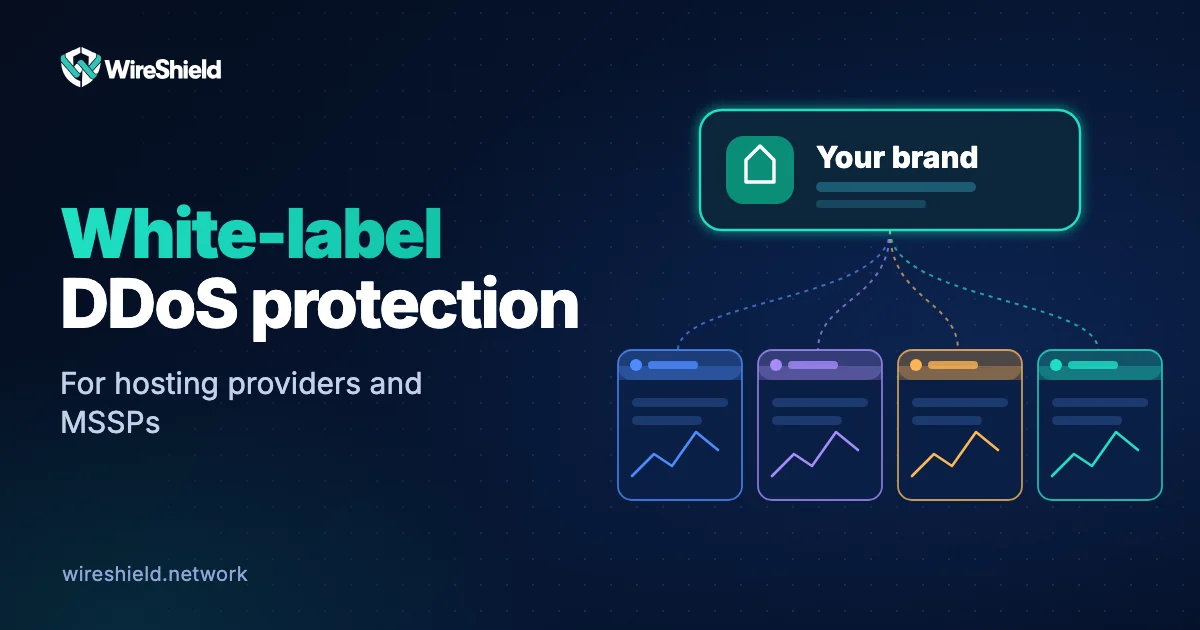
White-label DDoS protection is a model that lets you offer a protection service developed by another company to your own customers under your own brand. For hosting companies, internet service providers, cloud providers, agencies and managed security service (MSSP) companies, it creates a new revenue line and stronger customer loyalty without building the infrastructure from scratch. This guide explains the difference between white-label and reseller models, who needs them and what to look for when choosing.
Three related concepts are often confused:
| Model | What it means | Whose brand? |
|---|---|---|
| Reseller | You sell the provider's service to your customers, often through the provider's account system | Usually the provider's |
| White-label | You offer the service under your own brand; the customer does not see the provider, or not prominently | Yours |
| Multi-tenant management | You manage many customers from one panel, with quotas and permissions | Varies by model |
A real need is usually a mix of the three: each customer has their own panel, you manage all customers from one place and you deliver the service under your own brand.
WireShield has two different structures for two different layers:
Web Protection (HTTP/L7): Web Protection is used in two ways, and the features are exactly the same in both.
The challenge page customers see can also be customised: you can show your own logo and texts.
Network protection (L3/L4): For providers that protect many customers, the MSSP & Partners platform offers a multi-tenant operator portal:
The two structures complement each other: you can offer your network with Remote or Inline protection and your customers' web applications with Web Protection in the same portfolio. To choose between the models see inline or remote.
No. In reselling you mostly sell the service under the provider's brand. With white-label you offer it under your own brand. In practice the two are often used together.
In Web Protection you can show your own logo and texts on the challenge page, and with the self-hosted option you can use it under your own brand. We clarify details in the technical discussion.
No. Web Protection features are exactly the same in the cloud and on-premise options.
The operator portal is designed to manage many customers with quotas and permissions. Share the scale you expect in the technical discussion and we will plan together.
It depends on the domains and applications to protect, traffic volume and policy needs. After a technical assessment we prepare an offer that fits.
If you want to offer the service under your own brand, describe your customer profile and the scale you expect. You can look at the cloud and on-premise options on the Web Protection page or talk to the technical team.
Product Update
WireShield Team · 5 min read
Read post
Contact our team to talk through your technical needs.