Attack Analysis
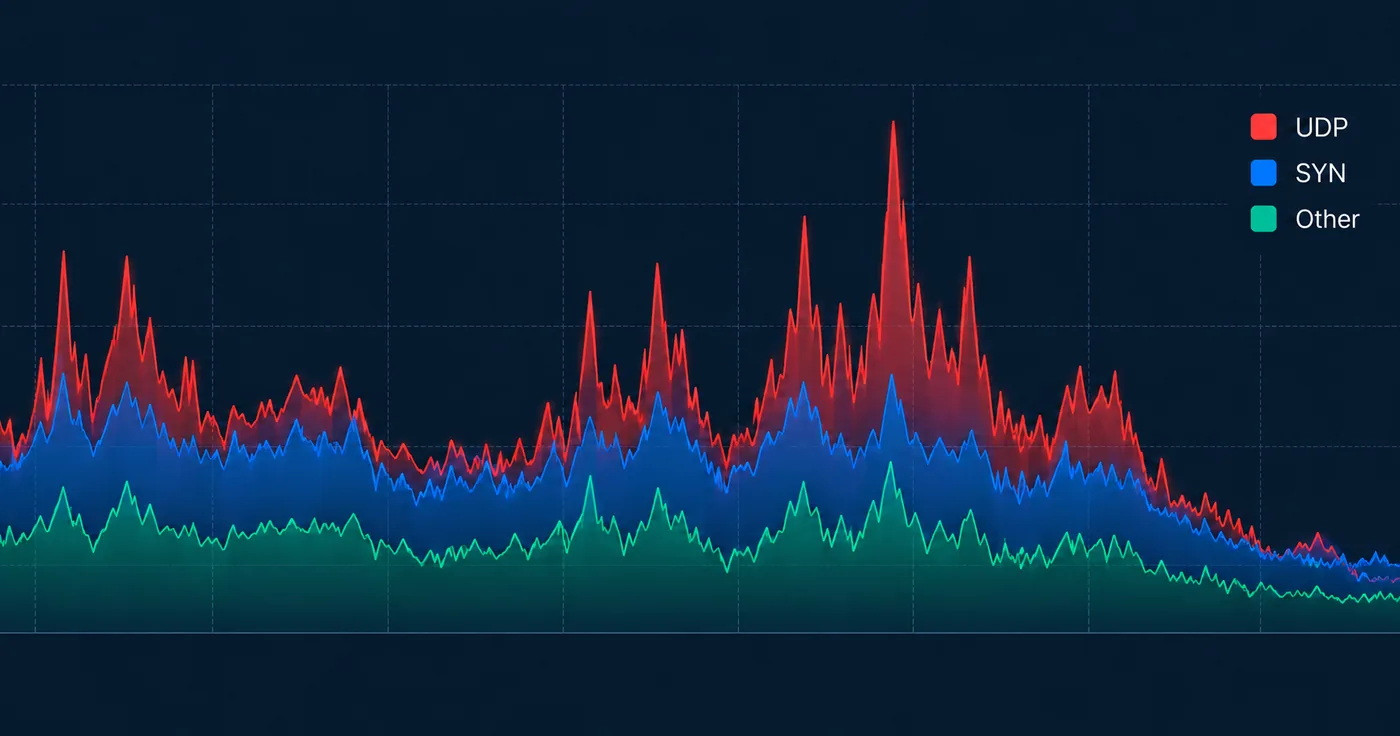
What should you monitor during a UDP flood?
 WireShield Team · 7 min read
Read post


Attack Analysis
Compare UDP flood, SYN flood, DNS amplification, HTTP flood and Rapid Reset: how each DDoS attack type works, how it shows up and how it is defended, in one place.
WireShield Team
6 min read
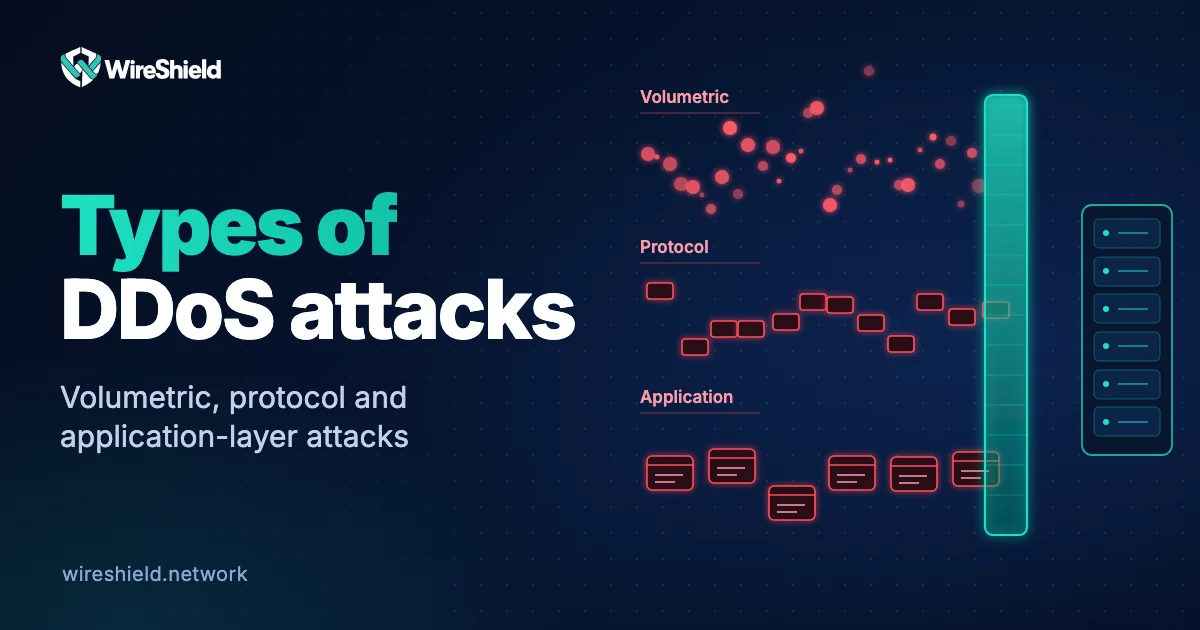
The main types of DDoS attacks fall into three groups depending on which resource they exhaust: volumetric attacks fill bandwidth, protocol attacks exhaust the connection and packet-processing capacity of network devices, and application-layer attacks target the request capacity of a web server or application. Defending well starts with knowing which group you are facing, because a measure that works against one type can be useless against another. We explained the general idea in what is a DDoS attack; here we look at each type more closely.
| Group | Target resource | Example attacks | Where it is stopped |
|---|---|---|---|
| Volumetric | Link bandwidth | UDP flood, ICMP flood, DNS/NTP/memcached amplification | In front of the link (remote protection) |
| Protocol | Connection tables, packet processing | SYN flood, ACK/RST flood, fragmented packets | At the network edge (inline or remote) |
| Application layer | Web server, application, API | HTTP flood, slow request attacks, HTTP/2 Rapid Reset | At the HTTP layer (WAF, rate limiting) |
Volumetric attacks try to fill the target's internet link. Once the link is full, traffic is lost before it reaches the server, so nothing you do on the server helps.
UDP is connectionless and the source address is easy to spoof. The attacker sends a large number of UDP packets to random ports on the target. Individual packets mean nothing; the damage comes from total volume. Because source addresses are spoofed, blocking them one by one is not possible. We covered what to watch in the UDP flood guide.
The attacker sends small requests to open services with the victim's address as the spoofed source. The service sends much larger responses to the victim. The bandwidth amplification factors in CISA's published table are:
| Protocol | Amplification factor |
|---|---|
| NTP | 556.9 |
| CharGEN | 358.8 |
| DNS | 28 – 54 |
| SSDP | 30.8 |
| CLDAP | 56 – 70 |
| Memcached | 10,000 – 51,000 |
The best-known example is the memcached attack that hit GitHub at 1.35 Tbps on February 28, 2018. Reflection traffic typically arrives from legitimate service ports such as 53 or 123, as large responses to requests you never sent.
An attempt to fill the link or a device with ping packets. It is a small threat on its own but adds weight when combined with other methods.
Protocol attacks target not bandwidth but the connection tables of firewalls, load balancers and servers. They can do serious damage even at low volume.
A TCP connection is set up with a three-step handshake. The attacker sends many SYN packets and never completes the handshake. While the server holds the half-open connections, the table fills and new real connections are refused. The IETF's RFC 4987 describes this attack and its common mitigations. An effective defence is to answer SYNs from unverified sources without keeping state and to verify the real client.
Invalid or out-of-context ACK, RST or abnormal-flag packets wear out stateful devices. The defence is to verify whether the packet belongs to an existing connection.
The attacker sends fragments that are hard to reassemble or meaningless. Reassembly consumes the memory and CPU of the device.
Application-layer attacks use HTTP requests that look legitimate. The volume can be low, so link monitoring may miss them. They aim at endpoints that run database queries or render expensive pages.
Many GET or POST requests exhaust the server's processing power. The requests can look like a real browser. The defence is to separate legitimate traffic by request rate, behaviour and browser verification.
Attacks such as Slowloris keep connections open by sending them very slowly. Once the server's concurrent connection limit is full, new visitors cannot get in.
Disclosed in 2023, this attack opens and immediately cancels HTTP/2 streams in a loop to wear out the server. According to Google, attacks in August 2023 reached more than 398 million requests per second; the flaw is tracked as CVE-2023-44487. Defence requires updating the server software and limiting request rates at the application layer.
Many real attacks do not stay with one method. For example, an attacker first fills the link with UDP amplification and, while the defence reacts, targets the application with an HTTP flood. That is why protection has to cover both the network and the application layer:
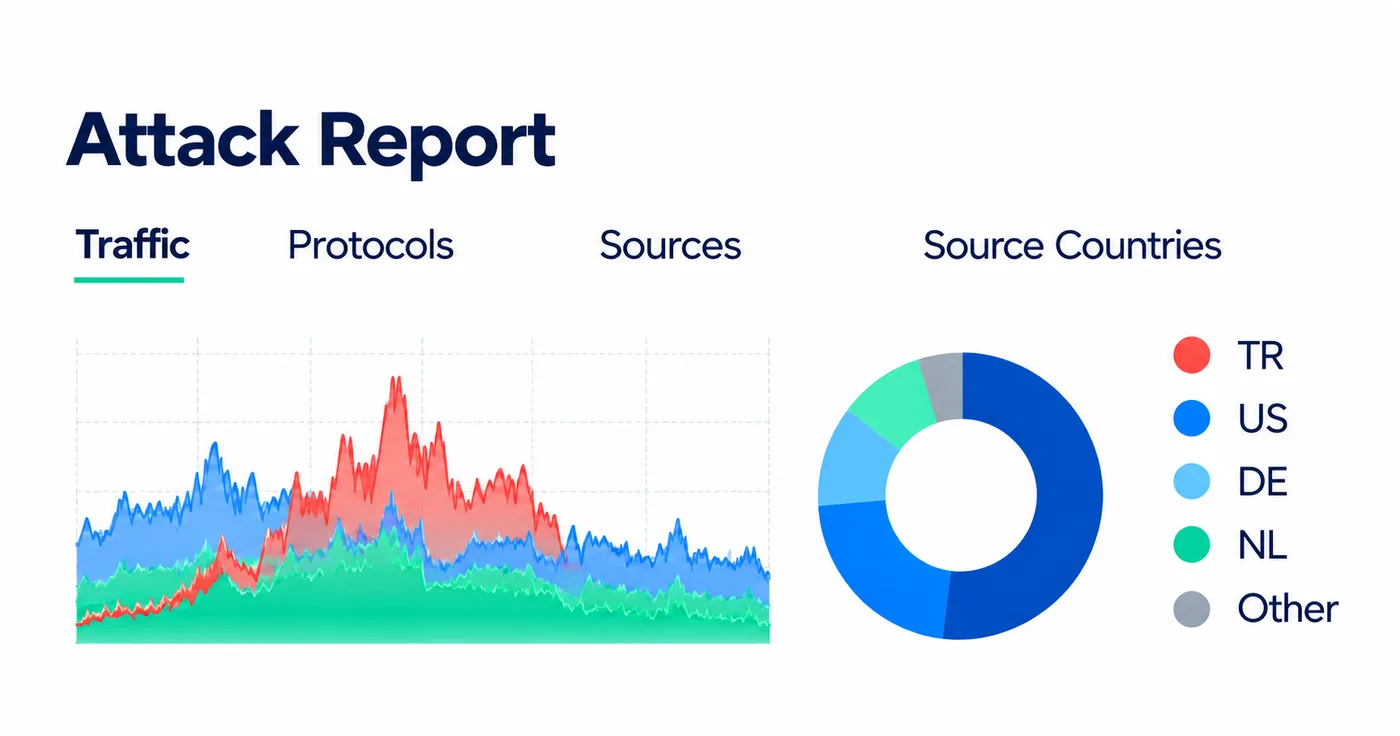
Our guide to reading attack reports helps with attack history and source distribution.
Volumetric attacks, especially UDP-based ones, are common because they are easy to carry out. Application-layer attacks are growing as well.
It depends on the target. A volumetric attack above your link capacity cannot be solved on the server; a low-volume application attack is dangerous because it is hard to detect.
The attacker spends little bandwidth while open services multiply the traffic sent to the victim. In the memcached case the factor reaches tens of thousands.
A SYN flood aims to fill the TCP connection table; a UDP flood aims to fill the link or the device's packet processing. One is connection-focused, the other volume-focused.
You need remote or inline protection for link-level attacks and a WAF with rate limiting for HTTP-level attacks. Neither replaces the other.
Tell us which attack type you have faced or are worried about, and we will work out which protection is needed at which layer. You can talk to the technical team.
Attack Analysis
WireShield Team · 6 min read
Read post
Attack Analysis
WireShield Team · 4 min read
Read post
Contact our team to talk through your technical needs.