Attack Analysis
What is a DDoS attack? How it works and how to protect against it
 WireShield Team · 6 min read
Read post


Attack Analysis
A DoS attack comes from one source, a DDoS attack from many devices at once. Learn the difference, why DDoS is harder to block and how to defend against each.
WireShield Team
5 min read
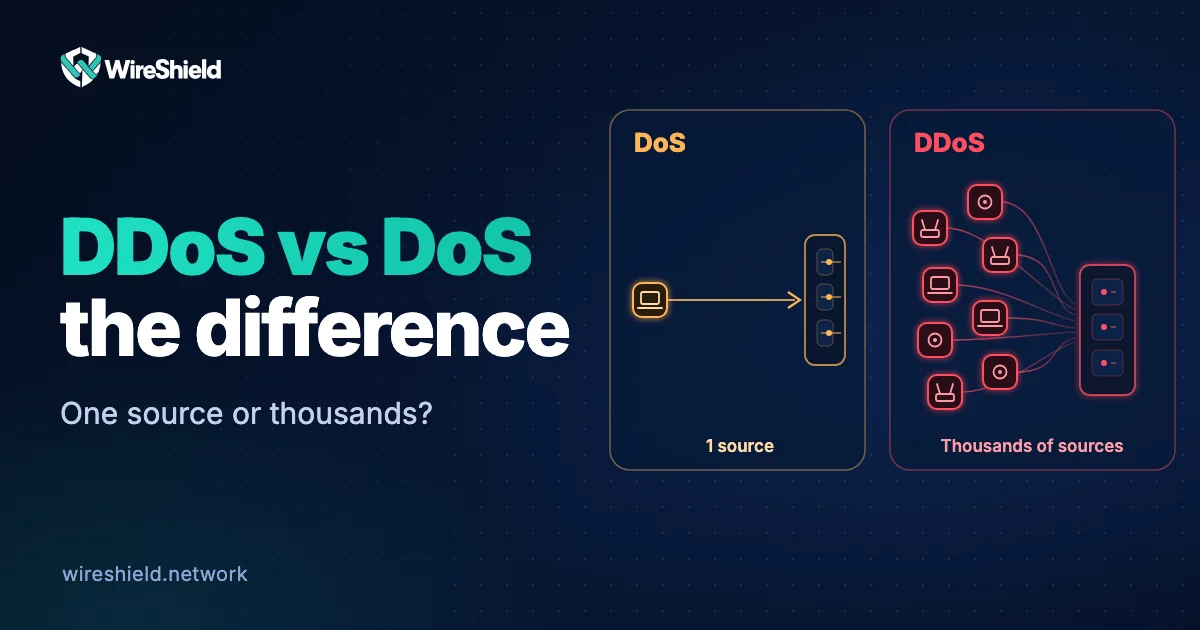
The main difference between DoS and DDoS is the number of sources: a DoS (denial-of-service) attack comes from a single source, while a DDoS (distributed denial-of-service) attack comes from many devices acting together. The result is the same, a service that legitimate users cannot reach, but the difficulty of defending is very different. The US cybersecurity agency CISA makes the same distinction: a standard DoS comes from one source, whereas a DDoS is "multiple machines operating together" against one target.
In a DoS attack the attacker tries to harm the target from one computer or one connection. It comes in two main forms:
Because it comes from one source, a DoS attack can usually be stopped by blocking the source IP address.
In a DDoS attack the traffic comes from a botnet, often thousands of compromised devices. The attacker controls the devices remotely and tells them all to hit the target at the same moment. Another method is reflection and amplification through open services; in that case the traffic comes not from the attacker's devices but from third-party servers. For the general picture see what is a DDoS attack.
| DoS | DDoS | |
|---|---|---|
| Number of sources | One | Hundreds, thousands, sometimes millions |
| Traffic volume | Usually limited | High, can reach Tbps levels |
| Blocking the source | Can be stopped by blocking one IP | Blocking one by one is not practical |
| Tracing the attacker | Relatively easy | Hard, as sources are scattered and often spoofed |
| Cost of attack | Low, with low impact | Cheap through a botnet or rented service, with high impact |
| Typical defence | IP blocking, software patch | Filtering in front of the link, behavioural analysis |
For DoS:
For DDoS:
No. A flaw-based DoS can crash a service with a single packet. The difference is in volume and how hard it is to block; the damage depends on the software flaw.
Yes. DDoS is the distributed form of DoS; every DDoS attack is a denial-of-service attack, but not every DoS attack is distributed.
If the traffic or requests come from very few IP addresses, it is most likely DoS. If the source distribution is wide and spans many countries, think DDoS.
Only to a limited extent. When there are many sources and the addresses are spoofed, blocking one by one fails. You need filtering in front of the link and behaviour-based rules.
Most volumetric attacks seen today are distributed. Single-source volume attacks are rarely effective against modern links.
Let us look at the source distribution and volume of the attack together. Share the traffic data you have and we will suggest the right protection model. You can talk to the technical team.
Attack Analysis
WireShield Team · 6 min read
Read post
Attack Analysis
WireShield Team · 6 min read
Read post
Attack Analysis
WireShield Team · 6 min read
Read post
Contact our team to talk through your technical needs.